
For more than forty years the military deception decoy had one face: the inflatable. Tanks, guns and aircraft in coated fabric, air-inflated, fielded by NATO and Warsaw Pact armies alike to fool aerial and satellite reconnaissance. The principle worked as long as the adversary watched from far away and high up. The FPV drone changed that equation.
The inflatable decoy: a Cold War legacy
The inflatable decoy was built for a precise threat model: high-altitude, top-down observation by optical sensors of limited resolution. Seen from a satellite or a reconnaissance aircraft kilometres away, an inflatable tank is indistinguishable from a real one. Light and compact to transport, it offered an unbeatable ratio of deceived surface to logistical volume for its time.
Its weaknesses were tolerable as long as no one looked closely. They no longer are. The FPV drone flies fifty metres off the ground and its camera feeds an operator analysing in real time at short range. At that distance the folds of the fabric, the lack of surface relief, the oscillation in the slightest breeze and the thermal uniformity of the material betray the decoy in seconds. The inflatable was designed for a distant eye; it fails before a close one.
Rigid versus inflatable: the comparison
The table below summarises the structural differences between the two families on the criteria that determine a decoy's effectiveness in high intensity.
| Criterion | Inflatable decoy | MilDecPro rigid polystyrene decoy |
|---|---|---|
| Deployment | Inflation system required, logistics dependency | Immediate, single operator, no tools |
| Fragment resistance | Punctures and deflates under fragments or vegetation | Solid structure, no puncture risk |
| Visual fidelity | Folds and deformations betray it at close range | Realistic surface relief, no wind oscillation |
| Temperature | Pressure and rigidity loss in hard frost | Operational −30 °C to +65 °C |
| Anchoring | Mandatory ground anchoring | No mandatory fixing, repositionable |
| Signatures | Optical only, IR hard to integrate | IR and radar reflector options available |
Rigid polystyrene: built for the drone threat
The rigid decoy in high-density expanded polystyrene, coated with two-part resin and painted to high fidelity, answers the inflatable's limits point by point. It has no membrane to puncture, no pressure to maintain, no pump to carry. Its solid shell presents a realistic surface relief that withstands the close analysis of an on-board camera. It does not move in the wind, does not tear under fragments and does not fail in frost.
This rigidity has a decisive operational corollary: deployment. Where an inflatable imposes a logistics chain, the rigid decoy is set down by a single soldier, without tools, and repositioned at will. In a doctrine that relies on regularly rotating positions to avoid identification, this mobility changes the very nature of the object.
MilDecPro, a French SME based in Clermont-Ferrand, manufactures its decoys in high-density expanded polystyrene coated with two-part resin. Selected by the French Defence Innovation Agency under FS51 (raising ground-soldier survivability), it was chosen for a trial contract in 2026.
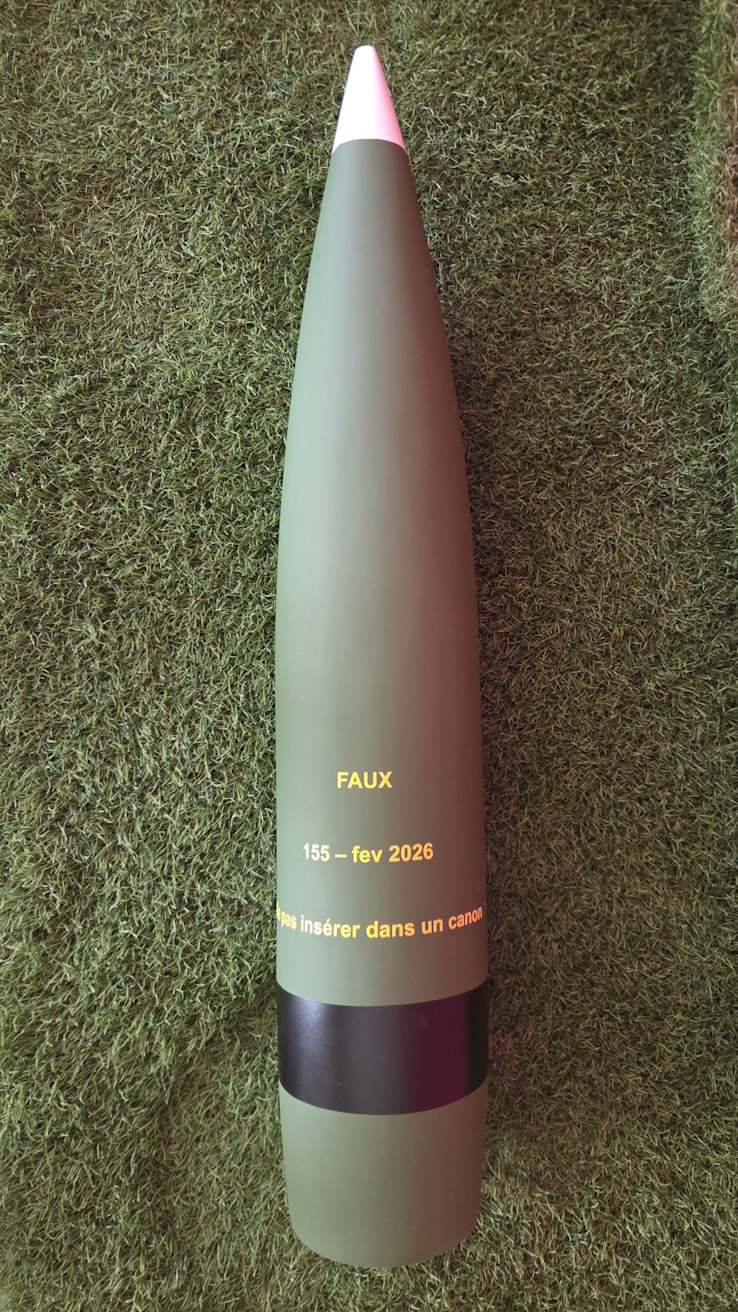
The range covers dummy anti-tank mines and teeth, shells, the Mistral system, and Cope Cage vehicle protection. IR and radar reflector options are available. The full MilDecPro decoy range details each silhouette.
A choice dictated by the battlefield
The inflatable decoy has not vanished: it keeps its value where the threat stays distant and compactness matters. But as soon as the FPV drone enters the equation, that is, on almost every current theatre, rigidity stops being a manufacturing detail and becomes the condition of the decoy's credibility. Drawing fire means being taken for a real target by a sensor watching closely. High-fidelity rigid polystyrene was designed for exactly that: to be consumed in place of the real thing, without ever revealing it was false.